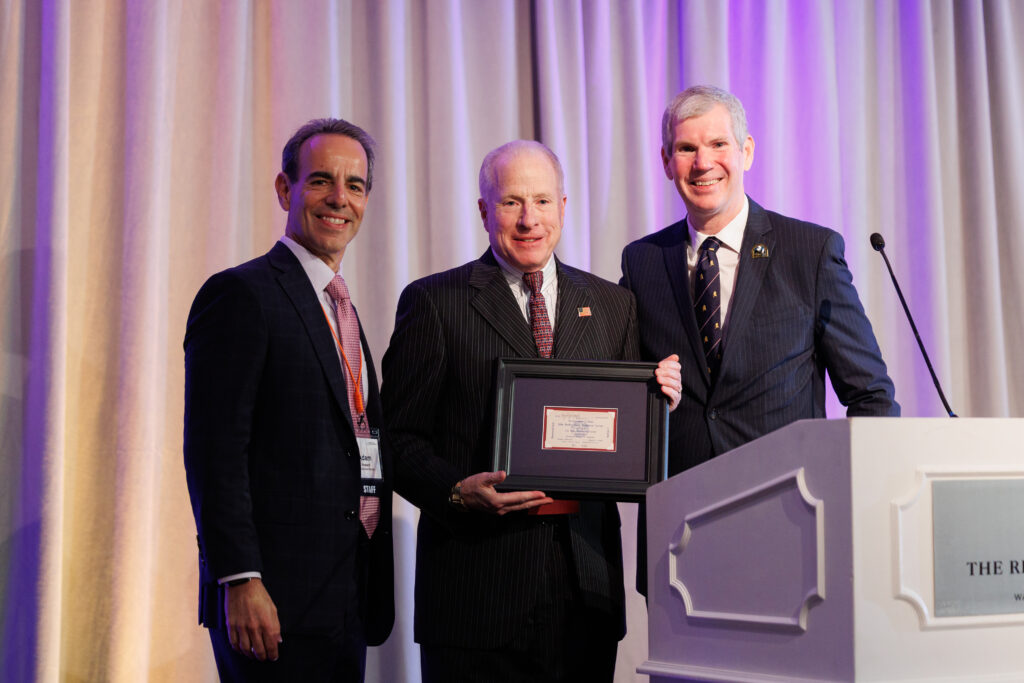
The Hottest Ticket in Town, 1946 By Donald P. Lofe, Jr. President and Chief Transformation Officer and Churchill Fellow, Westminster CollegeDirector, International Churchill Societ...
The armistice to end the First World War was signed on 11 November 1918, and determined a ceasefire at 11am that morning. This is now commemorated as Armistice Day, and each year at the eleventh hour of the eleventh day of the eleventh month there is a two-minute silence for people to pause and remember those who died during the conflict. Read Churchill’s own recollection of the day in , and also Dr Warren Dockter’s consideration of one of the most remarkable aspects of Churchill’s character in .
Churchill later gave an impromptu speech to a vast crowd from the balcony of the Ministry of Health at the lower end of Whitehall, telling the crowds, 'This is your victory!' to which they responded loudly: ‘No – it is yours!’ Later that evening, Churchill went out again on to the balcony to speak to the crowds. The last official event of VE Day was a broadcast to the nation by George VI at 9.00pm. Buckingham Palace was lit up by floodlights for the first time since the country had been forced into ‘blackout’ at the start of the War and two searchlights arced over St Paul’s Cathedral, which had withstood the German’s bombing, in a giant ‘V for Victory. In the early hours of 9 May, the celebratory lights were extinguished. The war against Japan was still to be won. Victory had been achieved at great cost – the lives of men, women and children; the destruction of homes and cities; the dislocation of peoples, exhaustion of finances and a weakened British economy. But Britain – led by Churchill, in his and Britain’s ‘finest hour’ – had achieved what it set out to do. Its people had dared and endured and seen victory, ‘in spite of terror’. They – and Churchill – had survived. And for one glorious day, VE Day, they could celebrate.
With the net tightening around Germany, on 4 February 1945 the Allied Leaders, Stalin, Churchill and Roosevelt, met in Yalta, on the Black Sea cost of the Crimea, to clarify their plans for the final offensive, the occupation policy for Germany and the establishment of the United Nations and its Security Council. A month later, in March 1945, the Germans were in retreat. The Allies were on the west bank of the Rhine, the traditional border of Germany that no foreign army had crossed in 140 years (since Napoleon on 1805). On 22-24 March, the Allies crossed the Rhine and entered enemy territory.On 30 April, Adolf Hitler committed suicide during the Battle of Berlin.
Friday 8 May 2015 was the anniversary of VE Day (Victory in Europe Day), marking seventy years since the end of the Second World War in Europe. The occasion was commemorated with a three-day weekend of remembrance and celebration, with events being held across the UK.
Buckingham Palace on VE Day: Despite the film slipping, and only partial sound, this clip still conveys the enormity of the crowds – and the occasion https://wwwyoutubecom/embed/_TDkwwkXqJY copyright: British...
The crossing of the Rhine in March 1945 was followed by the final German collapse On 3 May, more than half a million soldiers surrendered to Montgomery Another million followed: on...
VE Day Celebrations (1945) A Day that Shook the World The war in Europe is declared over as celebrations break out across Britain A Day That Shook The World is the classic...
copyright: IWM (BU 8962)...
Churchill waves to jubilant crowds from the balcony at the Ministry of Health, Whitehall, London copyright: IWM (H 41849)...
Get the Churchill Bulletin delivered to your inbox once a month.
Join the International Churchill Society today! Membership starts at just $29/year.