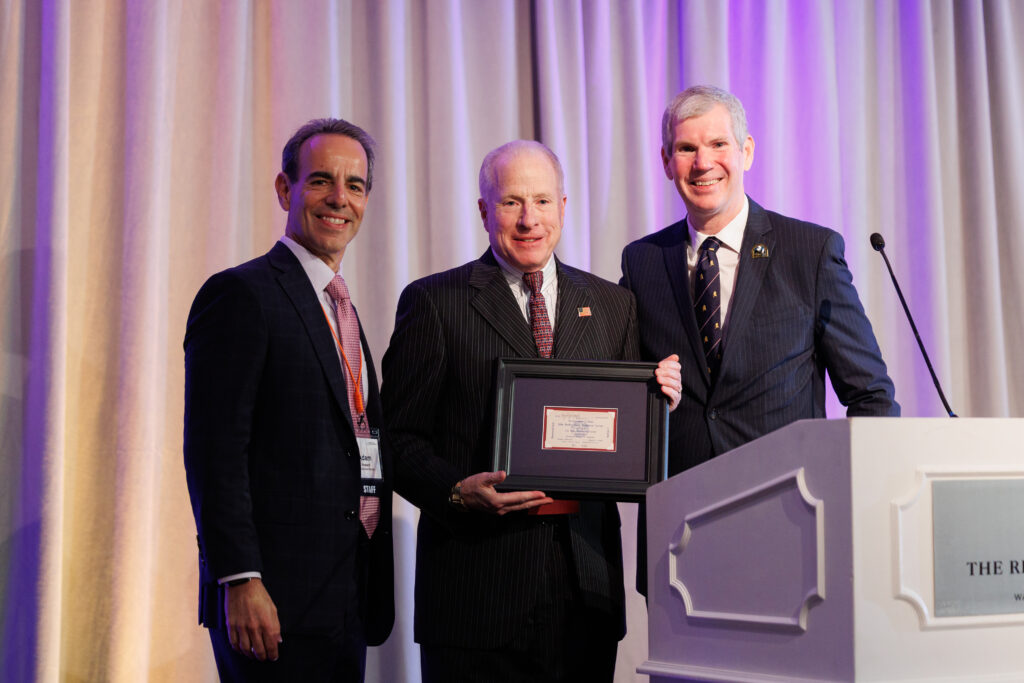
The Hottest Ticket in Town, 1946 By Donald P. Lofe, Jr. President and Chief Transformation Officer and Churchill Fellow, Westminster CollegeDirector, International Churchill Societ...
A few weeks before his eighth birthday, in 1882, Churchill – like many other children of his class and background – was sent away to boarding school. It was at his second school in Brighton (after two unhappy years at St George’s, Ascot where ‘floggings’ were common) that he learnt things that interested him; not just French and history, but riding a horse and swimming. Both riding and swimming were to feature heavily in his life. At Harrow he represented his house at swimming competitions, but it was at fencing that he excelled. In 1889, Churchill wrote to his ‘Darling Mummy’ asking her to allow him to take up fencing. Churchill went on to become an accomplished fencer and even became Public Schools Fencing Champion in 1892.
Typically adventurous, Churchill learnt to fly in 1913 when he was First Lord of the Admiralty, only ten years after the first aeroplane flight. At the time, the Royal Navy only had about a dozen aircraft and accidents were common. Planes weren’t very substantial; many of them couldn’t carry heavy loads, with some barely able to lift the pilot, never mind a co-pilot. Their engines were unreliable and even a modest wind could impede a flight. Flying these fragile planes required considerable skill as well as a great deal of luck.
By the time Churchill was facing another World War, in 1939, he understood more readily that while risks had to be taken, a balance needed to be struck between caution and ‘over-daring’. As Prime Minister, he walked the narrow road between the ‘precipices’ on either side; he needed nerves of steel to keep Britain and the Allies on the path to victory.
Away from the field of battle, Churchill’s risk-taking continued unabated. By January 1910, he was Home Secretary (his exploits in the war zones of the British Empire having succeeded in getting him into ‘the game of politics’) – and managed to engineer himself into the centre of the action.
Back home in Britain, in 1896, Churchill did all he could to get posted to Egypt or Matabeleland in South Africa, where he could see some action and get noticed – to no avail. He eventually sailed to India with his regiment in the Autumn of 1896. Confined to a life of polo and military routine in Bangalore, he eventually took matters into his own hands and, armed with a contract as a war correspondent for thetravelled to the North West frontier to join the Malakand Field Force. Here he did find himself in danger. Although the fighting on the north-west frontier against the Afghan tribes in 1897 couldn’t really be called battles, there was a real risk of being killed and Churchill had several narrow escapes. The campaign became the topic of Churchill’s first book, published in March 1898 – – in which Churchill discusses topics of relevance to the situation in Afghanistan today and which Coughlin cites as ‘required reading for military commanders on the ground, both British and American’.
After a few weeks as a Major with the 2nd Battalion, Grenadier Guards, in January 1916 he was appointed Lieutenant-Colonel, commanding the 6th Battalion, Royal Scots Fusiliers on the Western Front.
With all his writing and journalism gaining the attention of the political authorities (due in no small part to promotion of his activities by his mother Lady Randolph), he resigned from the army in April 1899. Politics beckoned. He had already spoken at a few political meetings in the Autumn of 1898 and attempted to enter Parliament as a Conservative, but failed – by a small margin – at the by-election in Oldham in 1899. But more action was to beckon. A serious colonial war had begun in South Africa and Churchill managed to secure another lucrative assignment to report on the war for the . The contract he negotiated with the newspaper, a salary of £250 a month and all expenses paid, made him the highest-paid war correspondent of the day.
In his last youthful military adventure, Churchill joined British forces in the Boer War. Churchill set off, armed with the important things in life – sixty bottles of spirits, twelve bottles of Rose’s Lime Juice and a supply of claret – and arrived in Cape Town late on 30 October 1899. He was famously captured only two weeks later by the Boers, when the armoured train on which he was travelling in Boer-occupied territory was ambushed and derailed. He made a dramatic escape the following month, making his way to Durban, with the Boers offering a reward of £25 for the recapture of their well-known prisoner, ‘dead or alive’. His dispatches from the Boer War were republished as two books, (1900) and (1900).
Desperate to join the army reconquering the Sudan, lost following the death of General Gordon in 1885, Churchill managed to obtain a temporary commission as a Lieutenant with the 21 Lancers while again also serving as a war correspondent, this time for the . In August 1898 he travelled up the Nile with the expeditionary force under General Kitchener.
Get the Churchill Bulletin delivered to your inbox once a month.
Join the International Churchill Society today! Membership starts at just $29/year.