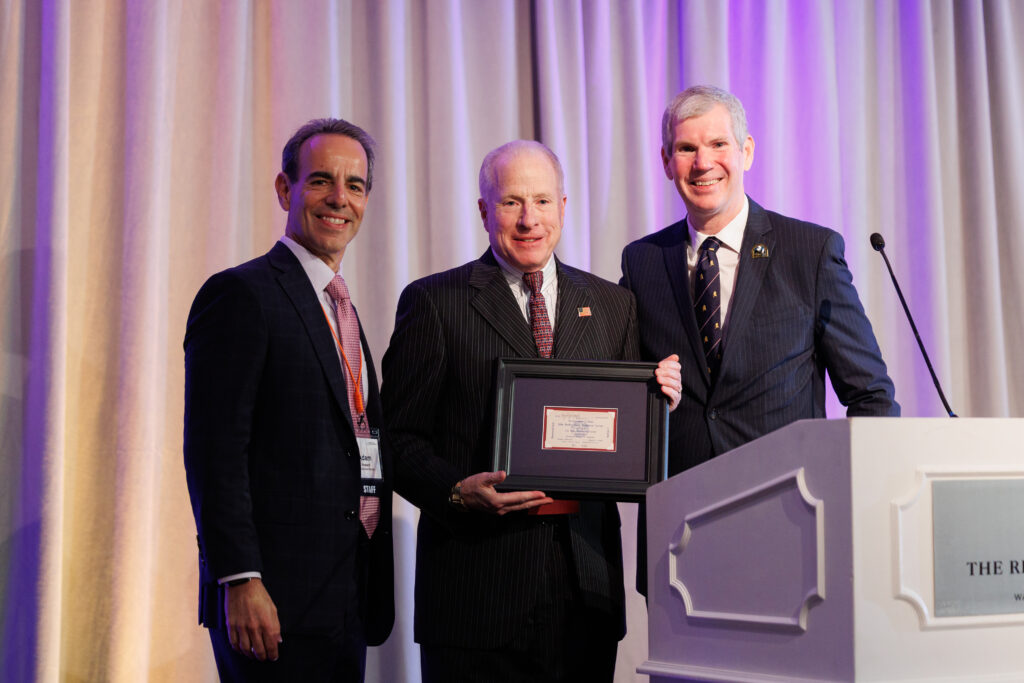
The Hottest Ticket in Town, 1946 By Donald P. Lofe, Jr. President and Chief Transformation Officer and Churchill Fellow, Westminster CollegeDirector, International Churchill Societ...
Introduced by Richard M Langworth...
Churchill died in 1965 and yet his name – and his legacy – lives on, in the educational organisations that he established in his lifetime and in the initiatives set up after his death, to promote excellence, innovation and leadership in education and research in science, technology, health and welfare and the arts. Churchill cared passionately about the future of his country and believed strongly in the importance of education and research in securing success and leadership in the years ahead.
When Churchill was eighty eight he was asked by the Duke of Edinburgh how he’d like to be remembered. He reportedly replied that he’d like a scholarship named after him. A Foundation was created as a vehicle for the Churchill Scholarship in July 1959. Now called the Winston Churchill Foundation of the US, it’s a reminder of Anglo–US cooperation and friendship.
2015 also sees the fiftieth anniversary of the Trust established as Churchill’s memorial. After his death, the Winston Churchill Memorial Trust was set up as Churchill’s national memorial and living legacy by funding British citizens from all walks of life to travel overseas, to develop their knowledge and expertise and bring back best practice for the benefit of others in their professions and communities. Since 1965, the Trust has supported thousands of Fellowship recipients in a diverse variety of fields, where merit, either on the basis of past experience, or potential, and the propensity to contribute to the community have been the only criteria. In 2015, 150 awards will be made for overseas travel of between four and eight weeks, with grants to cover all travel, daily costs and insurance. Echoing Churchill’s own interests and passions in his lifetime, wide-ranging categories include: Arts and Older People; Crafts and Makers; Designers; Early Years Prevention and Intervention; Education; Environment and Sustainable Living; Medicine, Health and Patient Care; Prison and Penal Reform; Science, Technology and Innovation; and Young People. Learn more about the Winston Churchill Memorial Trust .
Churchill was sent to Harrow School in London in 1888. Although he didn't particularly excel academically, it was at Harrow that he began to show a strong interest in soldiering and an ability to memorise lines and deliver impressive speeches.
To get young Americans studying at the new Churchill College, Cambridge, a Foundation was created as a vehicle for the Churchill Scholarship in July 1959 (in fact, the Foundation predates the Royal Charter for Churchill College and has been a steady companion of the College from its creation). Now called the Winston Churchill Foundation of the US, it’s a reminder of Anglo–US cooperation and friendship. For more on the history of the Scholarship, click .
In 1892, when Churchill was 17, he won the Public Schools fencing championship, presaging his future career as a fighting man. Generally, however, his other achievements at school didn’t seem to suggest an academic future. His parents decided that he wasn’t university material and instead they wanted him to try to enter the Royal Military College at Sandhurst and the military career for which he had already shown an inclination. He left Harrow in 1892 and went to a ‘crammer’ to help him pass the entrance exam, which he eventually did on the third attempt in 1893. Churchill’s poor maths meant he couldn’t join the artillery and engineers, and he didn’t do well enough in the final exam to qualify for the infantry, much to his father’s disappointment. Against his father’s wishes, he qualified for a cavalry cadetship (the cavalry was more expensive than the infantry; the family would need to buy one or two costly ‘hunters’, polo ponies). Churchill’s love of horses continued throughout his life.
Churchill’s younger brother, Jack, was born in 1880, when Churchill was five. They saw little of their parents and both of them were looked after by a nanny. Mrs Everest (she was in fact a spinster; the ‘Mrs’ was an honorary title) was hired when Winston was only a few months old. The children led a peripatetic life, often travelling with her from their home in Ireland (the ‘Little Lodge’, where the Churchills lived when his grandfather, the 7 Duke of Marlborough, became Viceroy of Ireland), to the Isle of Wight, to Blenheim and to London. Churchill was enormously fond of Mrs Everest and called her ‘Woom’ or ’Woomany’. She exerted a considerable influence on him throughout his childhood until she died when he was a young man of twenty one (he was devastated by her death, and arranged for the erection of a headstone on her grave and paid an annual sum for its upkeep thereafter, a practice which has been continued to this day by The Churchill Centre and the Churchill family). For more about Churchill and his nanny, see the .
A few weeks before his eighth birthday, in 1882, Churchill – like many other children of his class and background – was sent away to boarding school. The school was St George’s, near Ascot, Berkshire. Like lots of schoolchildren, Churchill didn’t like school. Churchill later wrote about his schooldays: ‘It appeared that I was to go away from home for many weeks at a stretch in order to do lessons under masters… After all I was only seven, and I had been so happy in my nursery with all my toys. I had such wonderful toys … Now it was to be all lessons …’ () He was unhappy from the start, initially probably no unhappier than many children sent away to school at the time, although ‘floggings’ (beatings) were common. But the discipline of school life didn’t suit his independent spirit. After only two years at St George’s, he was sent to a school in Brighton, run by the two Misses Thomson (The Misses Thomson’s Preparatory School), where he learned things that interested him such as French, history, poetry, riding a horse and swimming.
Get the Churchill Bulletin delivered to your inbox once a month.
Join the International Churchill Society today! Membership starts at just $29/year.